
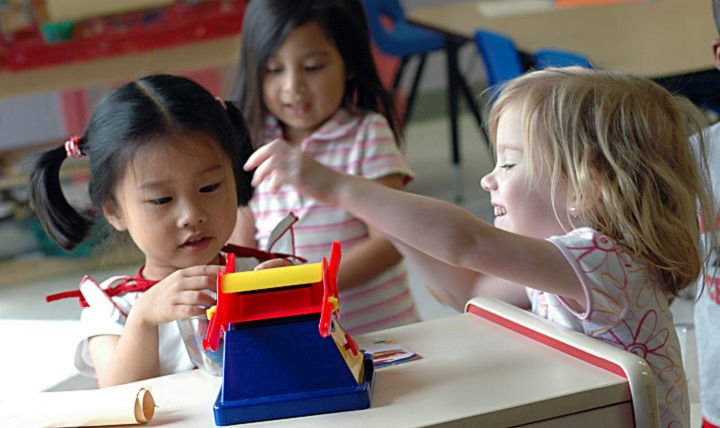

Play is the most natural way of learning for children, so why do we try to prevent our children from playing? Why do we ask them to stop playing? Why do we look for preschools or daycares that have a more serious setting, where play is limited?
Parents are bombarded with all kinds of information about how to raise their kids, what toys to buy for them, which classes to register them, etc. Some parents are even getting ready for their unborn child’s collage education, planning everything based on what is needed to be accepted to a certain collage. These might seem extreme to some, but they are the reality of the world we live in today.
Children learn the most important life skills through play. They learn how to use their body strength to climb or run. They also learn how to best communicate, socialize and negotiate with others during their play. They learn to share and make friends. They learn how to find their place and role in a group. Sometimes we feel children act like skilled politicians. We are right; they are using all the skills they’ve learned by playing or roleplaying to get what they want.
As parents and caregivers we can play an important role in children’s learning by providing the appropriate environment and conditions for them to play. By spending time playing with them, we can provide them the opportunity to enjoy and improve their life skills.
Children have different needs at different ages. Their development plays a big role in the type of play that is most appropriate for them. Babies up to three or four months old need close-by facial interaction. They love when mom or any caregiver holds them close to their face and talks to them. Talking to babies while feeding or changing them helps them learn the language faster. They also bond with the caregiver while interacting with her/him. At around four momonths, babiesiscover their own hands and fingers. They start playing with their fingers. Putting them in their mouth or sometimes pulling them with the other hand. At this stage they love to hold small objects. They mostly put these objects in their mouth. Providing them with colorful toys that make noises while moving and are easy to clean is a good option. Reading to children at any age is a great way to teach them the language. It is also a great activity to spend one on one time with your child. It is a good practice to talk to children in a descriptive way. For example, if you are playing with a ball, tell the child “ throw the big, white, round ball to me” It might sound funny to you, but it is the best way children learn. At about 18 months children can follow directions. Ask them to bring you their shoes so you can help them wear them to go out to play. Outdoor play is a great learning tool for children. Children are naturally calmer when they are in nature. Playing with a ball helps children exercise many skills. They use their fine motor skills or small muscles to hold the ball, their gross motor skills or large muscles to throw or run after the ball, they also use their eye and hand coordination skills to aim or catch the ball.
Pretend play is another great way for children to learn. They start by pretending they are doing something or they are someone other than themselves. This type of play allows their imagination to run wild. Encourage them by participating in their play. For example, if they are pretending they have baked a cake for you, pretend that you are eating it by making some comments, such as “oh, it is really hot, did you just get this from the oven”, or “ this tastes great, what kind of a cake is it?” let them continue with their play. Playing with water and sand not only gives children a lot of joy, it teaches them a lot about texture, temperature and the form of things. Play-doh is a great tool for children to learn how to use their fingers to create something. It is a great way to teach children how to hold a pencil. The Play-doh is an appropriate activity for toddlers.
The best way to teach children reading or math is by using puzzles or games. There are many puzzles in the market that teach children the alphabet and the numbers. Use every opportunity you get to emphasize on their learning. For example, if the child has learned the letter A and B, when you see a writing in the street or while reading them a book, ask the child to point out the letter As or Bs. When playing with them, ask them to bring you 2 of something or 4 of something. Then take one and ask them to put the remaining 1 or 3 back. This way you are teaching them math just by playing with them.
Although we sometimes tend to think that play is a waste of time, it is the best and most effective and natural way for children to learn. Teaching through play not only makes learning fun, it also makes it effective. If you turn every opportunity into a game or a play you will create the best results for your children. Use play as a tool to teach and to bond with your child. You will create lasting impressions on your children.
Eileen Manoukian
Doctoral Candidate in Early Childhood Education
Founder and director of Gem Educare
http://www.GemEducare.com

 Gem Educare